Ramon Figueiredo
Bachelor's degree and Master's degree in Computer Science
Ph.D. in Software and IT Engineering (Ph.D. Candidate)
Automatic Marker-less Kinematic Analysis of Diving and Diver’s 2D Pose
Conference: Canadian Sport Science
and Sports Innovation Conference (SPIN 2022)
Location: Vancouver, British Columbia, Canada
Date: December 2022
Authors: Ramon Figueiredo, Rachid Aissaoui, Mathieu Charbonneau, Carlos Vazquez
Abstract
Currently, diving coaches and the integrated support team (IST) members need an effective tool to measure the whole diving performance and to calculate specific variables identified by the literature. Develop a system for marker-less kinematic analysis of diving from a single and fixed camera, videos in sagittal view, with only one diver performing on a 3-meter springboard.
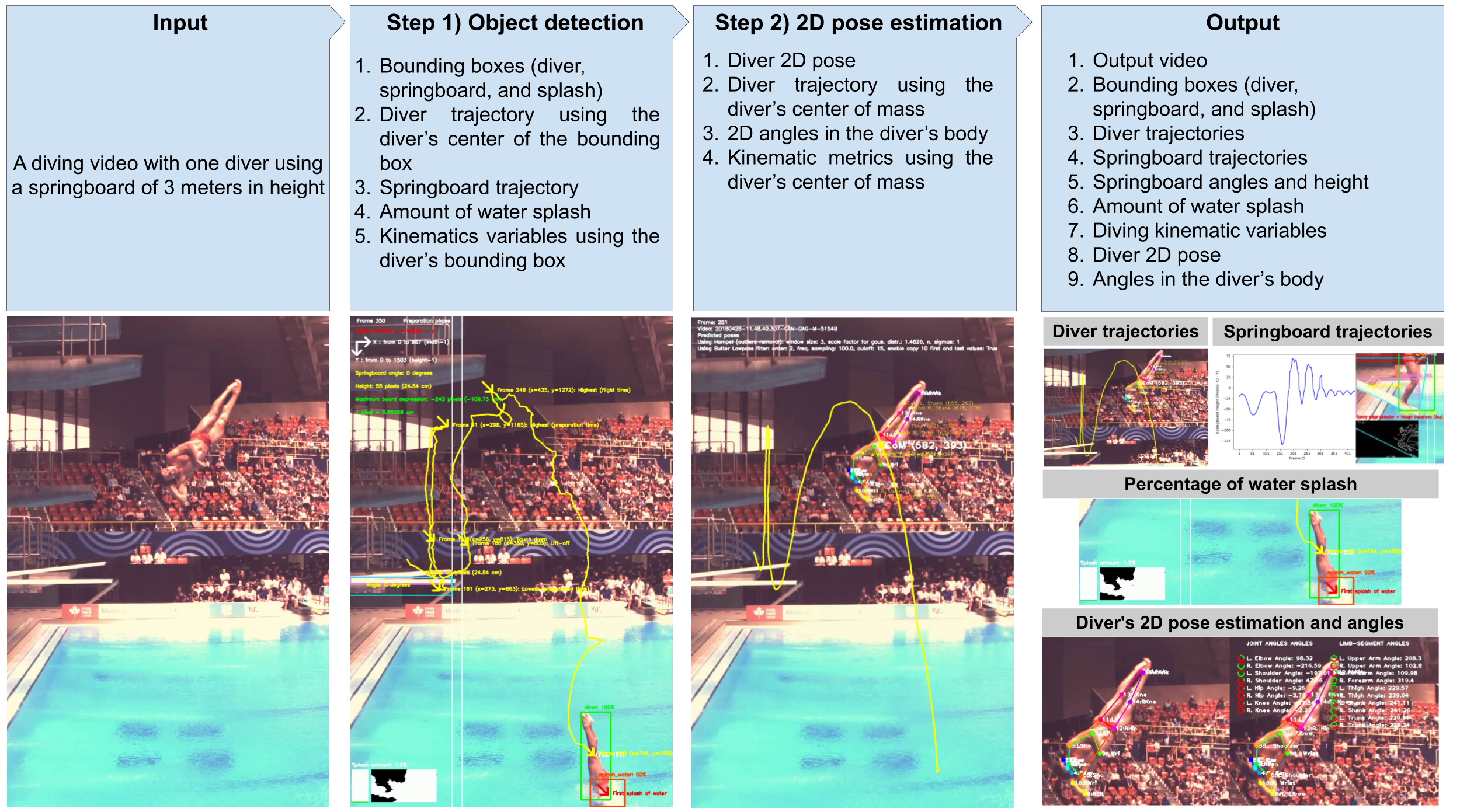
The proposed methodology is divided into two steps (Figure 1). Given a diving video, in the first step, a pre-trained Faster R-CNN [1] network was retrained on a newly built dataset of diving videos to detect divers, springboards and water splashes for each video frame. Then, for every frame, a kinematic analysis of diving is performed. The output includes diver trajectories, springboard angles and height, the amount of splash of water, and six kinematic variables chosen by coaches and biomechanics (1: the highest point in the preparation phase; 2: touch down; 3: maximum springboard depression; 4: lift-off; 5: the highest point in the flight time; 6: water contact).
In the second step, the diver’s pose is estimated using the HRNet [2] network that was also retrained on a new diving dataset created in this work. Finally, the output includes the diver’s center of mass trajectory (position, velocity and acceleration), the diver’s 2D pose and angles of the diver’s trunk, arms and legs.
To aggregate steps 1 and 2, the DivingFy web system is presented as a unified framework for the problem of marker-less analysis of diving, responsible for managing all the input and output described in the first and second steps.
The deep learning process and the evaluation of the robustness of the proposed solution used the proposed diving dataset DivingFy7797 with videos from Canadian athletes during the FINA Diving World Series in 2018 and 2019, hosted in Montreal, Canada. This dataset includes bounding box annotations and diver 2D pose annotations.
The new DivingFy system can measure diver kinematics and diving board motions during all diving phases and also estimate the splash size. The system also allows quick video search and visualization, and the presentation of results to coaches, IST members, and athletes.
Results
The object detection results showed that the proposed solution can detect diver, springboard, and water splash with an average precision (AP) greater than 91% using a confidence interval (C.I.) of 95% (Student’s T-Distribution):
- Diver AP: 99.58% ± 0.02%
- Springboard AP: 98.96% ± 0.001%
- Splash AP: 91.76% ± 0.12%
The diver 2D pose estimation results showed that the proposed solution predicts diver 2D poses with a precision of 97.04% ± 0.03%, also using a C.I. of 95%. The diver 2D pose estimation has an average mean per joint position error of 1.93 (cm).
This work bridges the gap between computer vision and biomechanics and takes advantage of deep learning technologies for kinematic analysis of diving. It provides a measuring tool that generates diver and springboard trajectories, the amount of water splash and diver 2D pose estimation with high accuracy. The results open new possibilities for advancing diving analysis.
Resources
BibTeX
@inproceedings{figueiredo2022divingfy,
title={Automatic marker-less kinematic analysis of diving and diver's 2D pose},
author={Figueiredo, Ramon and Aissaoui, Rachid and Charbonneau, Mathieu and Vazquez, Carlos},
booktitle={Canadian Sport Science and Sports Innovation Conference (SPIN 2022)},
year={2022},
month={December},
address={Vancouver, British Columbia, Canada},
note={Winner of the Best Work in Sports Innovation Award}
}
SPIN 2022 Conference Presentation
DivingFy Web System (Demonstration)
December 4, 2022: DivingFy Web System demonstration. Developed by Ramon Figueiredo.
DivingFy System – Version: 2022.11
A web system for kinematics analyses of diving. The project aimed to measure diver kinematics and diving board motions during all the phases of a dive (preparation, take-off, flight, and entry) to quantify the individual strategy, understood as motions and timings, used by top Canadian divers to achieve the best performance.
The DivingFy system was developed during Ramon Figueiredo Pessoa’s Ph.D. in Software and IT Engineering at École de Technologie Supérieure (ÉTS).
Principal investigators:
- Ph.D. student: Ramon Figueiredo Pessoa
- Ph.D. supervisor: Carlos Vazquez
- Ph.D. co-supervisor: Rachid Aissaoui
- Biomechanics Specialist (INS Québec): Mathieu Charbonneau
Ph.D. Research Featured on Radio-Canada Découverte
A quick overview of my Ph.D. project was broadcast by Radio-Canada Télévision (September 27, 2020). Video recordings from November 2019.
See subtitles (English) / Voir les sous-titres (Français) / Ver legendas (Português)